Culture is asserting its place in the national economy
Cultural professionals no longer want to be sidelined. At the Moroccan Forum of Cultural and Creative Industries (FOMICC), which recently took place in Rabat, the tone became more assertive. Cultural operators are raising their voices and want to finally be heard.
The message is clear: culture is not a luxury; it is an activity that generates value, jobs, and growth. The cultural and creative industries (CCIs) sector represents a real, productive, and job-creating economic sector, yet it is still too often overlooked in public policy. This stance is based on objective data, not on self-serving reflexes or posturing. It draws on a study conducted by the IFC (World Bank) and carried out by the consulting firm BearingPoint, in partnership with the Federation of Cultural and Creative Industries (FICC), the Moroccan Observatory of Very Small, Small, and Medium-Sized Enterprises (OMTPME), the High Commissioner’s Office for Planning (HCP) , and The state-owned financial institution Tamwilcom (National Corporation for Business Guarantees and Financing)Tamwilcom , a study which reshapes the landscape of the national debate.
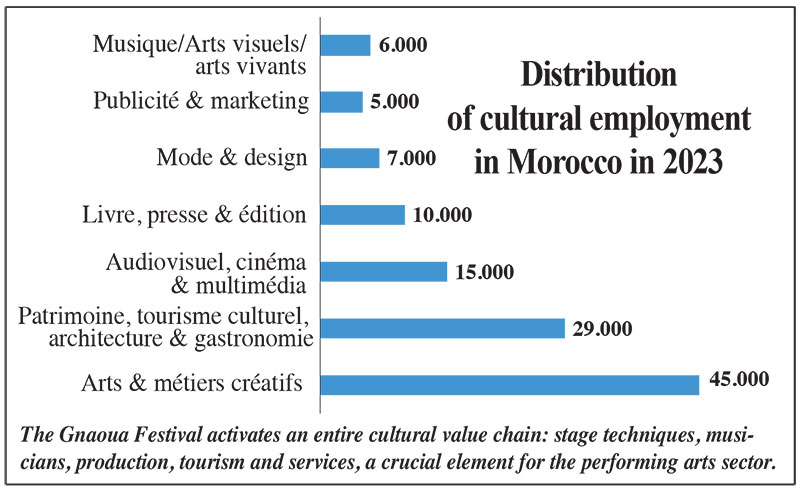
According to this study, cultural and creative industries already contribute nearly 2.4% of GDP, a level comparable to sectors identified as strategic, such as extractive industries or transportation and logistics. The momentum is strong. Total formal and informal turnover is now close to MAD 50 billion (USD 5.46 billion), with growth of 18% in one year . The country has 9,500 creative businesses , the vast majority of which are very small enterprises (VSEs), and a total of 116,000 jobs , representing approximately 1% of the active population.
Above all, the sector boasts a ratio of 3.7 jobs created per million dirhams (USD 109,000) of added value, higher than that of the manufacturing sector . In other words, dirham for dirham, culture employs more people than industry. This foundation exists, it is now being measured, but it remains largely invisible in public policy decisions. Professionals are not calling for a general increase in subsidies. They are asking for a supportive environment . This begins with appropriate financial instruments: sector-specific guarantees, mixed funds, impact investing , and incentives for private philanthropy. These tools exist elsewhere and can easily be adapted locally. The environment also requires strengthening training programs and specialized incubators. Finally, it requires a national effort to address data, which is currently fragmented.
A sector that represents several percentage points of GDP cannot continue to exist without consolidated indicators to inform public policy. The FICC’s ambition is to reach 5% of GDP by 2030. This scenario is far from utopian. The sector expects an institutional and economic framework aligned with its true weight. As we approach 2030, further delaying this recognition would mean leaving a growth engine underutilized.
Amine Boushaba