Eid Al-Adha: Why Sheep Prices Are Making Heads Spin
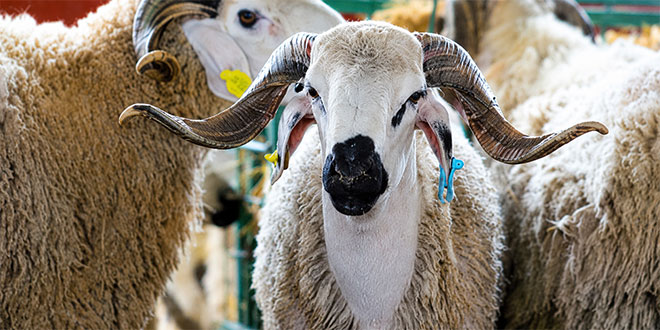
Highly prized in Morocco for the ritual sacrifice, the Sardi breed is distinguished by its white head, black muzzle and black markings around the eyes, earning it the nickname “the sheep with glasses” (Photo: L’Economiste)
D-15… With only two weeks left before the Feast of Sacrifice, uncertainty still surrounds sheep prices. Over the past few days, the unexplained surge in livestock prices has become the main topic of conversation among families, in neighborhoods, souks, cafés and even workplaces. At the same time, many households are betting on a possible decline in prices in the coming days.
As a result, many prefer to postpone their purchase until after May 20. This is particularly true in large cities, where apartment space is limited, as well as among civil servants, retirees and private-sector employees waiting for the early transfer of salaries and pensions for this month. So far, very few families have already purchased their sacrificial sheep. The reality is that people are not yet flocking to supermarkets, livestock pens, farms or weekly souks.
And for good reason: prices remain too high. According to several breeders, prices are expected to fall in the coming days due to abundant supply, whether for sheep, goats or cattle. Officially, more than 32 million head of livestock have been recorded. This is a record figure, especially considering that last year’s sacrifice was cancelled because of drought conditions following a national livestock census.
The Carcass Represents 50% of the Weight
That said, current prices for Sardi sheep — the most sought-after breed for sacrifice — range between 75 and 80 dirhams per kilogram. In other words, a 60-kilogram sheep costs between 4,500 and 4,800 dirhams. Including transportation costs, the total reaches around 5,000 dirhams.
It should also be noted that once slaughtered, the sheep weighs almost half of its initial live weight, as the carcass — including the head, legs and offal — accounts for nearly 50%.
“For a good Sardi sheep this year, buyers should expect to pay between 5,000 and 6,000 dirhams. In any case, we do not have any Sardi sheep for less than 4,000 dirhams,” explained a breeder and seller in the former slaughterhouse district of Hay Mohammadi in Casablanca.
Another highly valued breed in Morocco is the Bergui. Prices for this variety range between 70 and 75 dirhams per kilogram. For an average 50-kilogram sheep, buyers will have to pay between 3,500 and 3,750 dirhams on average.
For households with tighter budgets, there are imported sheep from Spain (Merino breed) and Romania, whose average prices generally range, depending on quality and weight, between 2,500 and 3,000 dirhams.
Faced with these high prices, many consumers prefer to wait. Others travel to farms or livestock pens in rural areas. Prices there are not necessarily lower either, but at least buyers feel reassured by the quality of breeding conditions and animal feed.
Today, soaring sheep prices are causing concern. Yet this year has been one of the rainiest in recent times, with significant improvement in pastures and good availability of animal feed. However, breeders also put forward legitimate arguments to explain current price levels. Most of them had to feed their livestock for at least one and a half to two years under extremely difficult conditions: drought, rainfall deficits, soaring feed prices in 2024 and 2025, last year’s cancellation of the sacrifice, fixed charges, production costs, veterinary care and other expenses.
As a result, many breeders are using this festive season as an opportunity to offset past losses and rising operating costs.
Amin RBOUB