
Employment: A rebound without stability
193,000 jobs created in one year. The figure marks a sharp rebound in the labor market in 2025. But behind this apparent improvement, structural imbalances remain: rising underemployment and persistent unemployment among young people and women. The recovery is well underway, but it remains unevenly distributed.
After a year in 2024 marked by the creation of only 82,000 jobs, the national economy accelerated in 2025, generating 193,000 net jobs. However, this momentum remains largely urban. Cities accounted for 203,000 net job creations, while rural areas recorded a loss of 10,000 jobs.
The recovery observed is also exclusively driven by paid employment. Its volume increased by 249,000 jobs in a single year, while unpaid employment fell by 55,000 jobs. In terms of sectors, services account for most of the job creation, with 123,000 jobs mainly in urban areas. Financial, real estate, scientific, and technical activities, as well as social services provided to communities, are among the main contributors.
Construction follows with 64,000 jobs, ahead of industry, which recorded 46,000 net job creations. In contrast, the agriculture, forestry, and fishing sector continues to contract, losing 41,000 jobs over one year, particularly in rural areas.
These developments have resulted in a limited improvement in overall indicators. The employment rate rose slightly from 37.7% to 37.8%, while the labor force participation rate remained stable at 43.5% nationally. This virtual stability reflects the persistent difficulty in expanding labor market participation, particularly among women, whose labor force participation rate fell slightly to 19%.
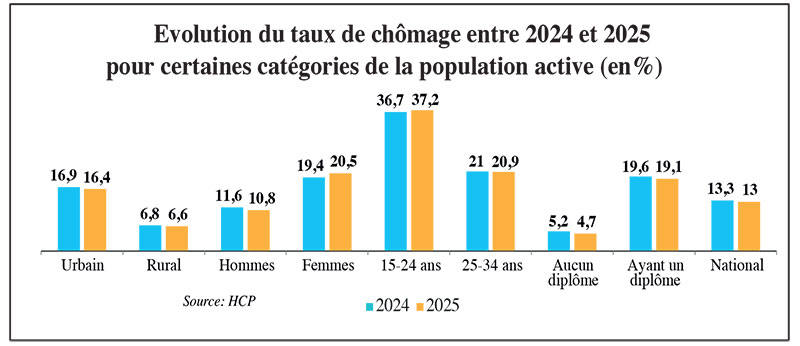
Unemployment, meanwhile, showed a moderate improvement. The number of unemployed fell by 17,000 to 1.621 million, and the national rate fell from 13.3% to 13%. However, this change remains very uneven across different categories. Unemployment is rising among young people aged 15 to 24, reaching 37.2%, and worsening among women, whose rate has risen from 19.4% to 20.5%. Behind this partial decline in unemployment, another indicator is deteriorating significantly: underemployment. The number of people affected rose from 1.082 million to 1.190 million, and the corresponding rate increased from 10.1% to 10.9%. The increase is widespread, affecting all sectors and all backgrounds.
Underemployment linked to insufficient income or a mismatch between training and employment now affects 573,000 people in work.
This discrepancy between quantitative employment recovery and persistent vulnerabilities reflects the characteristics of the growth model. The 2026 Economic Forecast Budget emphasizes that recent expansion remains mainly driven by domestic demand and investment, whose impact on the quality and inclusiveness of employment remains limited. This pattern explains the rise in underemployment and the difficulty in integrating young people and women into the labor market on a sustainable basis.
Khadija MASMOUDI