Employment, retirement, social assistance… BAM’s warnings
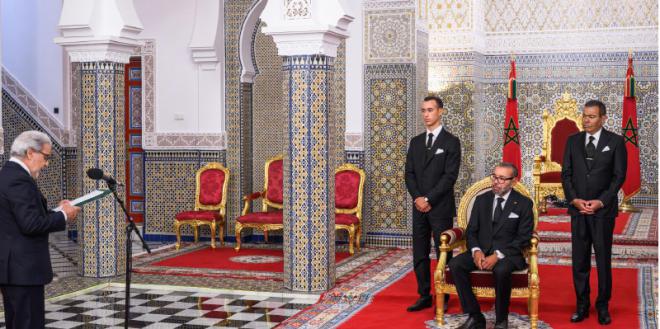
By 2030, Morocco will face major milestones, including the Sustainable Development Goals, numerous sectoral plans and strategies, but also the organization of the soccer World Cup. So many challenges to be met, according to Abdellatif Jouahri, Governor of the Central bank, who presented to the King the annual report on the economic, monetary, and financial situation for the 2024 financial year, on the occasion of Throne Day
Despite the succession of years of drought, the national economy shows notable resilience. This situation, confirmed by international institutions (IMF, World Bank, OECD, UNCTAD , etc.), was recalled by Abdellatif Jouahri, Governor of Bank Al-Maghrib, who presented to the Sovereign the central bank’s annual report on the economic, monetary and financial situation for the 2024 financial year, on the occasion of the Throne Day.
– FDIs: Expectations on growth and employment
In terms of foreign direct investment, Morocco has certainly established itself as one of the best-performing countries on the continent, but the real challenge lies in the knock-on effects of these investments on growth and employment. To improve the local content of exportable products, it would be necessary to strengthen the involvement of private operators and national investment funds, particularly the Mohammed VI Fund. This is all the more important given that the foreign exchange balance of these investments has been in deficit for the second consecutive year. Total sales and repatriations in the form of dividends exceed the amount of incoming investment flows.
– Sustainability of direct assistance: Pressure on public resources also stems from efforts to build a welfare state. Direct assistance (to the low-income population), implemented as part of the generalization of social protection, absorbs significant resources, estimated at more than 24 billion Moroccan Dirhams (US 2.6 billion) in 2024. The direct assistance program requires a sustainable financing mechanism and alignment with its ultimate goal, that of empowering the population that experiences difficulties. To prevent direct assistance from turning into a program where citizens are dependent on Government assistance, eligibility criteria should be reassessed on a regular basis to improve the efficiency of targeting programs, to reaffirm the temporary nature of beneficiary status, and thus promote the transition to productive employment.
– Fragmentation of the productive fabric: On the economic front, the greatest weakness lies in the fragmentation of the productive fabric. Available data shows that the productive fabric is largely dominated by VSEs, a large proportion of which operate in informal activities with low added value and little competitiveness. Strengthening this fabric and getting the private sector to play its rightful role in investment and job creation remains a major challenge.
begins upstream by improving the education and training system, an area where there are significant gaps. Downstream, strengthening this fabric requires promoting the spirit of entrepreneurship, institutionalizing supervision and monitoring, particularly for very small businesses, as well as continuing to improve the business climate.
Fatim-Zahra TOHRY