Fuel: Competition Council scrutinizes prices
Geopolitical tensions in the Middle East are causing volatile spikes in oil prices, exposing Morocco—a net importer—to these fluctuations. A new significant increase in fuel prices was reported by industry professionals on Wednesday, April 1, 2026.
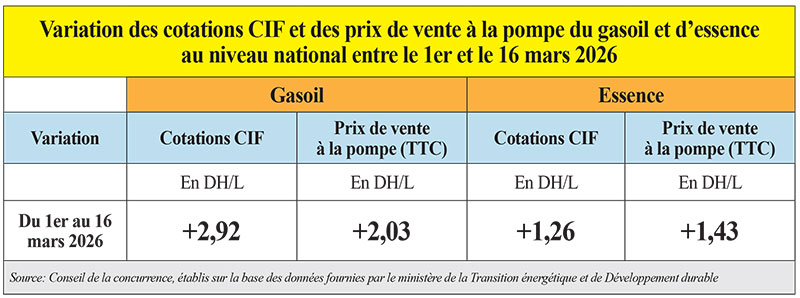
In accordance with its monitoring mandate, the Competition Council conducted hearings with the main players in the diesel and gasoline distribution sector to examine the correlation between changes in international prices (March 01–16, 2026) and their impact on domestic purchase costs and retail prices. Summary of the report on “Trends in diesel and gasoline prices on international markets and their impact on retail prices at the pump in the domestic market—Period from March 01 to March 16, 2026”.
■ Mixed picture: A comparison of changes in CIF prices with retail prices at the pump reveals significant discrepancies. For diesel, the increase in international prices amounts to +2.92 Dirhams per Liter, while retail prices at the pump rose by +2.03 Dirhams per liter. This change reflects a partial pass-through of -0.89 MAD per liter, corresponding to an estimated pass-through rate of 69.5%. Regarding gasoline, international prices rose by +1.26 MAD/liter, while retail prices at the pump increased by +1.43 MAD/liter, resulting in a difference of +0.17 MAD/liter. Overall, the observed trends reveal relatively varied pass-through differentials from one operator to another, reflecting heterogeneity in the adjustments, according to the Competition Council’s report.
■ Transfer price: Differentiation upstream, alignment downstream Although the average increase in pump prices since March 16th is approximately +2 MAD/L for diesel and nearly +1.4 MAD/L for gasoline, an examination of the data provided by the operators interviewed reveals that the transfer prices applied to service station managers varied, with differences amounting to nearly 0.20 MAD/L for diesel, representing almost 10% of the average increase observed. Furthermore, the analysis of the data provided suggests that price revisions are not strictly synchronized across service stations. However, at a more detailed level, service stations tend to adjust their prices based on those charged in their immediate vicinity.
■ Monthly Update: Monitoring Prices, Costs, and Margins
The purpose of this note is to analyze the evolution of international refined product prices over this period, as well as their impact on pump prices starting March 16. This analysis will be supplemented as part of the monthly market monitoring, which includes a review of quotations, purchase costs, selling prices, and gross margins.
Fatim-Zahra TOHRY
Gas stations’ outcry against distributors
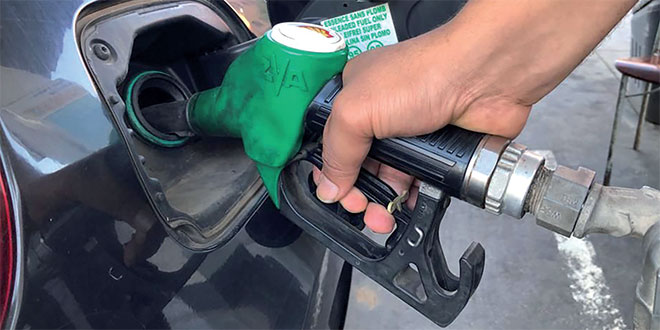
According to the National Federation of Gas Station Owners, Merchants, and Managers, the actions of distributors have put managers on the front lines of users’ anger
The National Federation of Gas Station Owners, Merchants, and Managers in Morocco (FNPCGS) is raising a ruckus. It leveled serious accusations against distributors during a hearing before the Competition Council, which focused on fuel price fluctuations at the international and national levels, as well as supply conditions.
In its statement, this professional body, chaired by Jamal Zrikem, called out the “unfair practice s” of fuel distributors. “Since March 15, we have noted that certain companies have significantly reduced the volume of deliveries to gas stations, while other chains, under the pretext of insufficient stock, have completely refused to respond to supply requests”, the Federation lamented.
This situation, adds the trade association, has created a certain degree of “chaos” at gas stations and put station managers on the front lines of dealing with angry customers. Customers were demanding fuel, and gas stations were unable to meet that demand. “Station owners were forced to manage long lines of consumers who wanted to fill up before the first fuel price hike, announced on March 16, took effect”, explained gas station representatives to the Competition Council, who added that: “Some stations were forced to shut down”. “These actions raise questions about the ethical and legal responsibility of distributors”, said the Federation.
It went on to openly accuse distributors of “economic hegemony” and “opportunism” , which contravene the basic rules of fair competition.
The Federation is therefore calling on the authorities to intervene so that the incidents of March 15 do not happen again, and to ensure «the protection» of stations against the «monopolistic» practices of distributors.
Khadija SKALLI