
Lawyers Await Constitutional Court’s Ruling
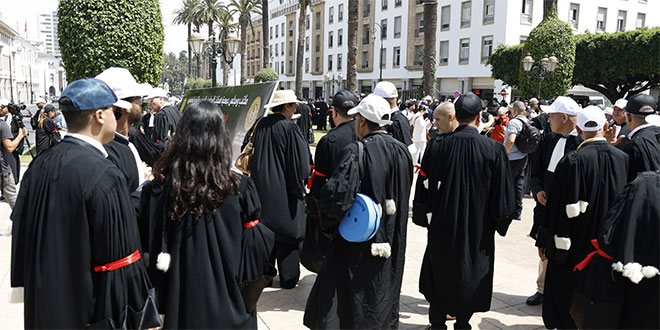
Despite the judicial recess, which runs until September 8 and has suspended ordinary court hearings except for urgent cases, lawyers are maintaining pressure on the authorities.Before leaving for the summer break, they decided to continue their boycott of professional activities in protest against the new law governing the legal profession, which was recently passed by Parliament.
Since the Speaker of the House of Representatives referred the law to the Constitutional Court for review, the legal profession has been closely awaiting the institution’s ruling. Rachid Talbi Alami took this step in light of the public debate sparked by the legislation, with the aim of easing tensions.
Some lawyers have also threatened to take the matter before specialized international bodies. However, if the Constitutional Court upholds the constitutionality of the law, the matter will effectively be settled.
While awaiting the Court’s decision, lawyers remain hopeful that at least one or two provisions will be struck down as unconstitutional.
Their optimism is reinforced by what they describe as a commitment from the Head of Government.
According to a source close to the matter, Aziz Akhannouch reportedly assured them that he would not convene an extraordinary parliamentary session if the Constitutional Court finds that one or more provisions of the law governing the legal profession are unconstitutional.
As a result, Parliament would not amend the legislation during the current legislative term.
Responsibility for the matter would therefore be deferred to the next government, which would decide how to proceed.
In that scenario, the law would not be published in the Official Gazette and would therefore not enter into force. If this happens, lawyers are expected to resume their normal court activities.
■ Financial Governance
One of the most contentious innovations concerns financial governance.
The new law introduces an unprecedented measure placing lawyers’ deposit and settlement accounts under the oversight of the Court of Auditors.
The Court would be responsible for verifying the regularity of financial transactions, while local bar associations would be required to submit a detailed annual report on the management of these funds. Lawyers argue that this provision is unconstitutional.
They contend that the Court of Auditors is mandated to oversee public funds, whereas the funds held in bar association deposit accounts are private funds.o
M.C.