Medusa submarine cable: Mega-project connecting Europe, Morocco, and Africa
A major step forward in telecoms infrastructure that strengthens Morocco’s digital sovereignty and position at the crossroads of international connectivity routes between Europe and Africa.
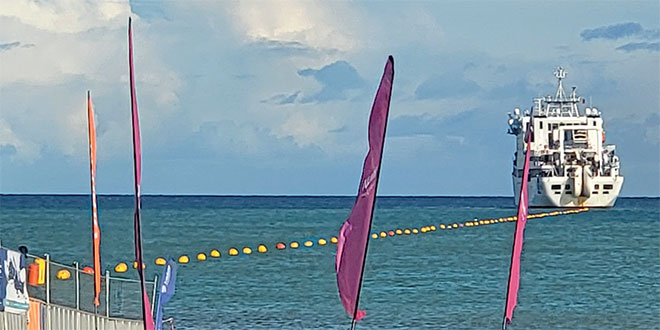
Médusa teams pulling the submarine cable at Arkmane beach, about 20 kilometers from Nador, when the cable-laying ship arrived on December 16 (Ph. Abdellah El Kassri)
On Tuesday, December 16, the two operators Orange and Inwi celebrated together the landing of the Medusa submarine cable on Arkman beach, 25 km from Nador (in the Oriental region). This is a highly symbolic event that concretely illustrates the sharing and pooling of cutting-edge infrastructure between the two operators, just after the rollout of 5G in Morocco. The new landing point for this mega-interconnection project (via Nador) comes at just the right time to position Morocco at the heart of the major connectivity routes linking North Africa to Europe and the wider Mediterranean area. This is the largest high-capacity fiber optic submarine cable system in the Mediterranean. The cable stretches over a distance of 8,700 km and connects 12 countries on both sides of the Mediterranean with 18 landing points in Europe and North Africa. With a total capacity of 20 Tbps (terabits per second), the cable meets the growing demand for bandwidth. This will strengthen the resilience of digital exchanges between Europe and Africa.
The choice of Nador is no coincidence. It is the site that offers the most guarantees in terms of maritime traffic and security. In addition, Nador will deliver strategic projects in a few months, such as the gas terminal, the NWM (Nador West Med) port, highways, rail infrastructure, the Marchica seaside resort, and more. which will make it a major economic hub.
According to Norman Albi, CEO of Médusa, “Morocco was the first to install the submarine cable, which will be operational in February 2026, following testing and validation over the next two months.” The cable now connects Nador to Marseille via Spain (Barcelona), Portugal (Lisbon), Italy, Malta, Greece, Cyprus, Algeria, Tunisia, Libya, Egypt, Jordan, Syria, and more. «International connectivity is a major focus. It is a strategic opportunity to enhance attractiveness, economic competitiveness, digital resilience, and more. The arrival of the cable in Nador comes three years after the initial project contract was signed with Médusa. So, despite the constraints of this type of infrastructure, we are on schedule,» said Hind El Fal, Chief Business Officer of Orange Morocco. 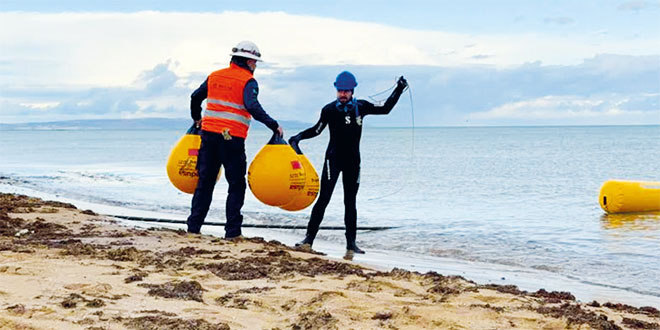 According to Mehdi Lahlou, CTO (Chief Technology Officer) at Inwi: «W We are witnessing an extremely important event for Morocco’s international connectivity. It is a defining step toward improving sovereignty and resilience… This project is not a one-off initiative; it illustrates the Kingdom’s ambition to position itself as an international digital hub. Through these cutting-edge infrastructures, the ambition is to strengthen the value proposition of the two operators in order to offer access to the capillarity of international networks and the digital ecosystem of Mediterranean countries. The Medusa cable project is not an isolated investment. According to Orange Morocco, it is part of a broader vision of African connectivity. In short, the French group plans to integrate the Djoliba backbone in the future. This is a fiber optic network that spans more than 20,000 km in West Africa.
It should be noted that submarine cable infrastructure is increasingly crucial to the functioning of digitally connected economies and societies (universities, academic research, businesses, economic competitiveness, etc.). They are conduits for sensitive data such as emails, bank transfers, money transfers, WhatsApp messages, social media content, and more. Dependence on this type of investment continues to grow, as it offers the advantage of a resilient, distributed, and differentiated network.
Cable Landing Station (CLS)
TO accommodate the cable and optimize its benefits in Morocco, Orange Morocco designed and built the Cable Landing Station (CLS) in 15 months with the help of Finatech (a technology subsidiary of the FinanceCom group). It is a state-of-the-art infrastructure covering 3,500 m². It offers IT capacity of 140 kW and scalable international connectivity of up to 20 Tbps (terabits per second). This station, which is open to all operators, is a key asset for hosting future submarine cables and other partners, hyperscalers, etc.
Four major steps
One of the major milestones in the arrival of the longest submarine cable in the Mediterranean in Morocco was its landing at Kariat Arekmane beach in Nador. The cable then passes through the BMH (Beach Manhole), which acts as a connection chamber through which the pipe rises. This is followed by the fronthaul, a secure link stretching 2.5 km between Arekmane beach and the Cable Landing Station (CLS), which is also a state-of-the-art data center housing the submarine cable termination equipment.
Amin RBOUB