Monetary status quo: BAM still prioritizes stability
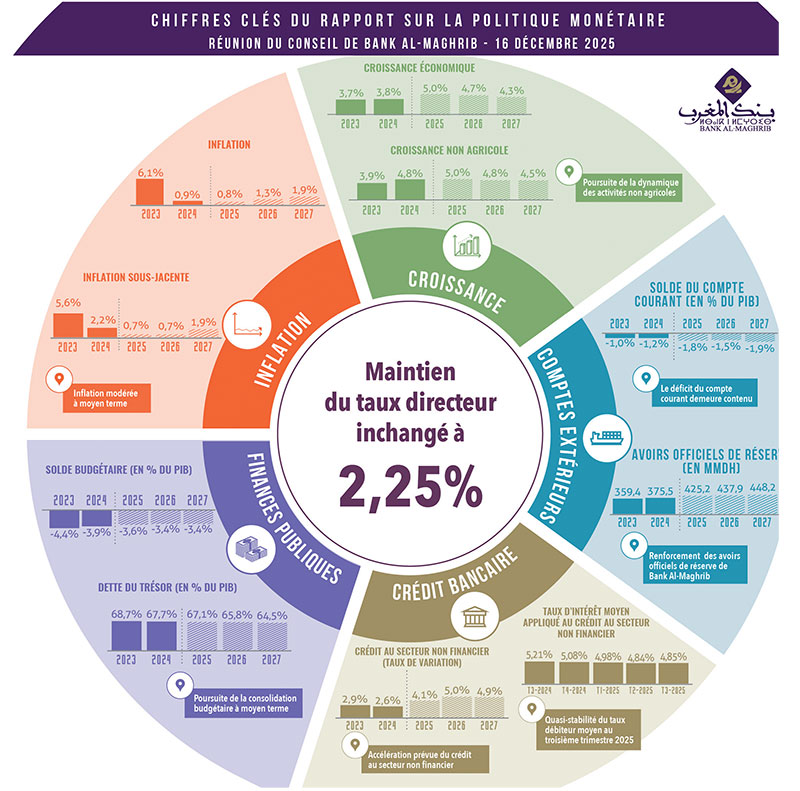
Unsurprisingly, the central bank (Bank Al-Maghrib, BAM ) opted for continuity. Meeting in Rabat on Tuesday, December 16, for its final session of the year, its Board decided to maintain its key interest rate unchanged at 2.25%. This status quo was widely expected by the markets and reflects a period of monetary stability that began several months ago.
This choice reflects a cautious approach. The international environment remains uncertain: geoeconomic tensions persist, and trade policies remain difficult to predict. The geopolitical context also remains unstable. While a relative easing of trade tensions has been observed and the US fiscal impasse has ended, visibility remains insufficient to justify an immediate adjustment of monetary policy. The Governing Council considers the current level of the policy rate « appropriate « at this stage of the cycle, and the central bank thus reserves the right to adjust its policy when conditions are fully favorable, beyond 2025.
Domestically, the situation is more favorable. The economy is benefiting from strong performance in non-agricultural activities, the labor market is showing signs of recovery, and investment remains robust. This momentum is reinforced by the guidelines of the 2026 Finance Law and the 2026-2028 three-year budget program. These confirm the continuation of fiscal consolidation and a gradual reduction in Treasury debt. All of these factors contribute to stabilizing macroeconomic expectations and reducing immediate pressure on monetary policy.
Meanwhile, inflation remains low. It averaged 0.8% over the first ten months of 2025, driven by improved supply of certain food products and lower fuel prices. According to Bank Al-Maghrib, however, this inflation is expected to gradually increase to 1.3% in 2026 and then 1.9% in 2027. Core inflation is expected to follow a similar trajectory, remaining moderate in the short term before picking up by 2027. Despite this context, the central bank has chosen not to further ease its monetary policy, preferring to preserve its room for maneuver. Inflation expectations remain stable, with financial sector experts surveyed by Bank Al-Maghrib forecasting an average rate of 2% over the medium term, a signal considered reassuring for the credibility of the monetary framework.
In this context of controlled prices, growth momentum is another key element in Bank Al-Maghrib’s analysis. Growth projections reinforce this position: the national economy is expected to grow by 5% in 2025 and by an average of 4.5% in 2026 and 2027.
Khadija MASMOUDI