Morocco the Maritime Nation Has Always Existed… And Yet!
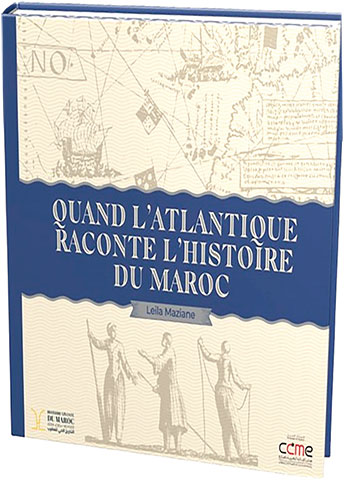
“Morocco has never turned its back on the sea.” With this statement, historian Laïla Meziane immediately challenges what she describes as “a widespread misconception” that still persists today. The dean of the Faculty of Letters and Human Sciences Ben M’sik at Hassan II University of Casablanca has just published When the Atlantic Tells the Story of Morocco. “This fascinating book revisits our relationship with Atlantic history and highlights the central role of the ocean in shaping and developing Morocco’s identity,” notes the Council of the Moroccan Community Abroad (CMME), which co-published the work with Maha Édition. Why this book, and why now?
“History helps us put things into perspective. The sea has always been part of this country’s destiny for thousands of years,” adds economist Driss Guerraoui, member of the Academy of the Kingdom of Morocco, during the presentation of the book on April 17, 2026, at the Hassan II Mosque Foundation as part of the Heritage Days of Casablanca. Research conducted by the National Institute of Archaeological and Heritage Sciences (INSAP) reinforces this heritage.
“In a cave near Essaouira, excavations uncovered Neolithic ornaments, including a shell necklace dating back 50,000 years. The use of and interaction with the sea can also be traced to the arrival of the Phoenicians on Moroccan shores -particularly along the Atlantic coast- around 800 BC,” the historian explains. As for the Mediterranean, it was the cradle of ancient civilizations. Tingis (present-day Tangier) was even perceived as “the end of the known world.”
The Carthaginians and later the Roman Empire succeeded one another along Morocco’s coasts, establishing trading posts and colonies. One example is Volubilis, near Meknes. This Roman city, built in 217 AD, “dominates our history textbooks. During Antiquity, Mauretania Tingitana (Morocco) was already integrated into maritime trade routes at a time when Carthage was the center of the world.” Coins, mosaics, tiles—the sea was present everywhere. Then came the era of the greatness of the Western Muslim Empire, stretching from the Atlantic Ocean to the Nile River—from Morocco to Egypt, and even extending toward Sudan.
“The Almohad Caliphate possessed 400 ships. This dynasty, originally from the southern desert regions, became ‘maritimized’ thanks to Andalusia,” explains the specialist in Moroccan maritime history.
Professor Laïla Meziane refers to both Arab and European sources, including The Sea and Western Muslims in the Middle Ages: 8th–13th Century by Christophe Picard. “The Muslim world would never again experience a similar power, either before or after the Almohads,” the speaker continues before an audience astonished by a history largely unknown to them.
Sultan Abu Yusuf Yaqub al-Mansur won the Battle of Alarcos in 1195 against the Christian kingdoms of Spain, earning him the title “The Victorious” within an empire “where the sun never set.” This placed the Almohad caliph among the great rulers of history alongside Alexander the Great and Ottoman Sultan Suleiman the Magnificent. The late French historian Jean-Louis Miège described “the circle of the strait” as “a connection marked by great mobility”—the internet before the internet, thanks to ports.
His Moroccan colleague elaborates on the idea: “Ports facing one another, such as Tangier and Tarifa. This maritime face-to-face relationship has endured through time. That is why I chose to take a broad approach to history and cartography…” in order to remind us of Morocco’s former grandeur.
Faiçal FAQUIHI