Pensions: Urgency catches up with Government a few months before legislative elections
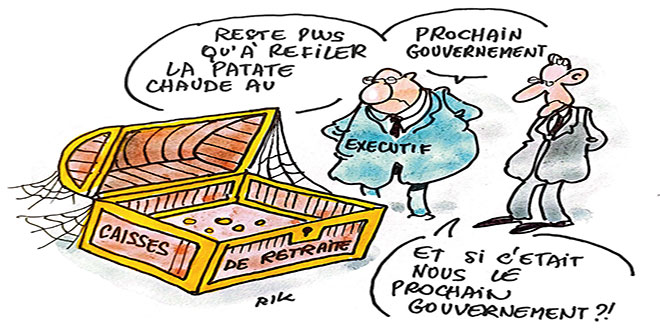
With a new round of discussions scheduled for Wednesday, December 17, pension reform is back in the spotlight, catching up with the Government in a particularly tight political calendar. The executive branch of Government no longer has the luxury of postponing this highly sensitive project: some pension funds, primarily the Moroccan Pension Fund (CMR), are approaching their limits.
With just a few months to go before the legislative elections, it is now forced to speed up the process. The stated goal is to achieve a stable scenario by spring 2026. To achieve this, it will have to reconcile financial viability, union demands, and the need to provide the country with a pension framework capable of withstanding the demographic shock of the coming decades. The task is immense, the schedule tight, and the room for maneuver narrow. With the elections approaching, every decision or lack of decision will have major economic, social, and political consequences.
However, the Government is moving forward with a clearly defined plan: to move toward a two-tier system, public and private, organize a coherent transition, and preserve acquired rights while defining a credible set of parameters. But behind this plan lies a heavy budgetary reality.
The Moroccan Pension Fund, the pillar of the public sector, has a technical deficit of more than MAD 7.4 billion (USD 800 million) for the civil pension scheme alone in 2024 and MAD 1.8 billion (USD 194 million) for the military pension scheme. The civil pension scheme is in a critical situation, with reserves projected to be depleted by 2031 if no reforms are made. At this stage, sustainability is no longer a distant issue but an immediate warning that weighs on government decisions and imposes a tight schedule.
Faced with such financial pressure, parametric reform is no longer a theoretical option but an unavoidable step. Raising the legal retirement age is at the heart of the discussions, even if the government is proceeding with caution. The civil service pension scheme has already been raised to 63 after several gradual adjustments. The RCAR (Group Retirement Benefit Plan), which covers a large proportion of public sector employees, is not aligned, even though its natural trajectory should, in theory, converge towards the same threshold. The question now is whether the executive will attempt to introduce a further increase to 65, at the risk of reigniting social tensions in a delicate electoral context. Added to this picture is the situation of the Group Retirement Benefit Plan, an essential pillar of the future public sector alongside the Moroccan Pension Fund (CMR).
Beyond age, other parameters are on the table: increasing contribution rates, methods for calculating pensions, etc. Technically speaking, the government has a relatively well-known margin for maneuver, but each option is met with acute social sensitivity.o
Khadija MADMOUDI