Public Finances: Record revenues, compensation makes a comeback
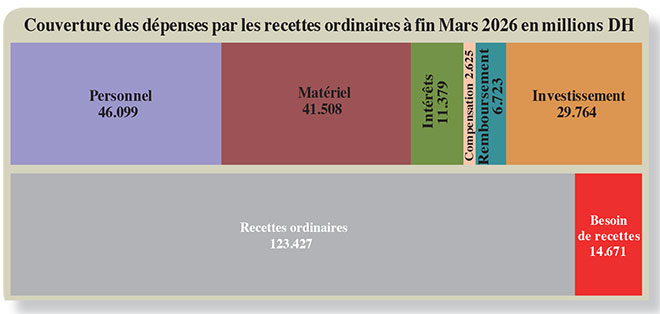
MAD 44.9 billion in corporate tax revenues in just three months. This first quarter alone is close to the total annual CIT collected in 2019, before Covid and the reform.
Launched in 2023 and set to conclude this year, the reform has fundamentally reshaped both the tax base and CIT rates. The target rate has been reduced to 20%, above the 15% minimum set by the OECD. Corporate tax accounts for 37.3% of net ordinary revenues in the general budget. It is the leading revenue source, far ahead of VAT and personal income tax. This concentration reflects the scale of the tax transformation and calls for close monitoring of trends in the coming quarters.
Personal income tax, down 9.7% to MAD 18.9 billion, should not be interpreted as a sign of distress. March 2025 collections included MAD 3.8 billion from the voluntary tax regularization introduced by the 2024 Finance Law. This was a one-off operation, with no equivalent this year. Behind CIT, VAT stands as the second pillar of revenues at MAD 27.8 billion, up 6.4% on a gross basis. Domestic VAT rose by 9.9% to MAD 13.7 billion, reflecting resilient household consumption and improved collection. Import VAT increased by only 3.3% to MAD 14.1 billion, indicating more moderate import demand for now. Domestic VAT is growing faster than import VAT, signaling sustained internal demand or a strengthening collection system. This picture is accompanied by another reality: VAT refunds are accelerating. At end-March 2026, domestic VAT reimbursements reached MAD 5 billion, up 18.2% year-on-year. In 2025, the Treasury refunded MAD 25 billion in VAT credits, compared to an annual average of MAD 7 billion before the reform.
The tax administration is now targeting “zero arrears,” with average reimbursement times reduced to two months. Withholding tax has contributed to this shift by securing collection while feeding the flow of refunds. Meanwhile, CIT refunds fell by 39.5% to MAD 1.4 billion.
The decline in CIT refunds and the increase in VAT reimbursements each reflect their own dynamics: the former stock was largely cleared last year, while the latter is still being absorbed.
Compensation: From zero to MAD 2.6 billion
At end-March, the Treasury had disbursed MAD 2.6 billion for compensation, compared to zero a year earlier. This return, after a blank year, is mainly driven by butane gas, whose cylinder price remains regulated and whose unit subsidy rose from MAD 30 to MAD 78 due to the direct impact of rising global prices linked to tensions in the Middle East.As far as butane is concerned, no structural reform is currently on the agenda: the State fully absorbs the increase. This remains a politically sensitive item. Fouzi Lekjaa has ruled out the need for an amending finance law, stating that the government will mobilize “all available budgetary leeway.” In the transport sector, the new mechanism—MAD 3 per liter of diesel consumed, via a dedicated targeting platform—replaces a previous scheme that mobilized nearly MAD 7 billion between 2022 and 2024 based on tonnage rather than actual activity. The new framework is more rigorous and already in effect: on April 21, the Ministry of Transport announced a 25% increase in aid for the tranche covering late April, citing continued fuel price increases. The monthly cost of the scheme, initially estimated at MAD 648 million, is therefore trending upward.
Khadija MASMOUDI