The family model is changing course
In three decades, the structure of Moroccan families has undergone profound transformation. The proportion of nuclear families has increased from 60.8% to 73% today, while intergenerational cohabitation has declined from 29% to 16.8%. Presented in Rabat by the High Commission for Planning, the preliminary results of the National Family Survey confirm the gradual establishment of a more compact domestic model, the implications of which extend beyond the private sphere to directly affect social policies.
«Families remain at the heart of Moroccan society, but they are evolving and adapting to new forms of vulnerability», stressed the High Commissioner for Planning, Chakib Benmoussa, during the presentation of the results.
The first observation is that extended families are rapidly losing their central role. Their share fell from 35.2% in 1995 to 19.8% in 2025, confirming a growing polarization of domestic organization around the parental unit. This trend is accompanied by a continued decrease in the average household size, now close to four people, which is contributing to a transformation of housing needs, particularly in large cities.
The changing residential patterns between generations is another key indicator. By 2025, less than half of households will still live in the same locality as their parents, which is changing the nature of intra-family interactions and reducing the frequency of local support networks.
Long perceived as primarily urban, this transformation now also affects rural areas. «We are seeing a very strong and rapid convergence between rural and urban family dynamics», noted sociologist Mohamed Tozy, highlighting the scale of the ongoing recompositions in forms of social organization.
«The dynamics of marriage are currently marked by a decline in the planning of marriage and by material constraints that are particularly pronounced among young people», said Chakib Benmoussa.
Another significant development is the increase in childless couples living in the same household, whose share has risen from 3% to over 9%. This is in fact a sign of a gradual aging of family structures and a diversification of domestic trajectories.
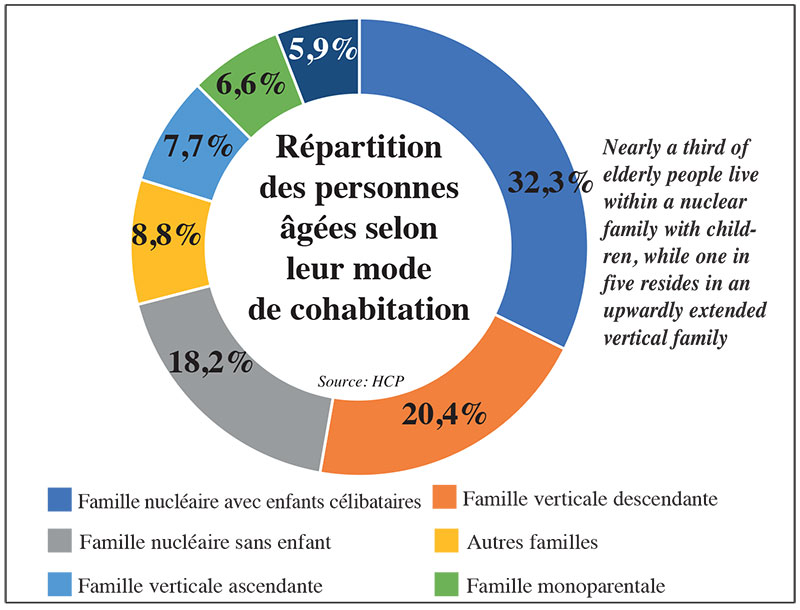
Family remains the primary living environment for older people. Three out of four seniors still live with at least one child, but their economic independence remains limited.
Despite these transformations, family solidarity continues to play a central role as a social safety net. As Mohamed Tozy pointed out, the family remains «the foundation of social solidarity», while now revealing more visible limitations, particularly in the care of elderly relatives and horizontal forms of support.
Khadija MASMOUDI