The reasons for the spectacular rebound of FDI
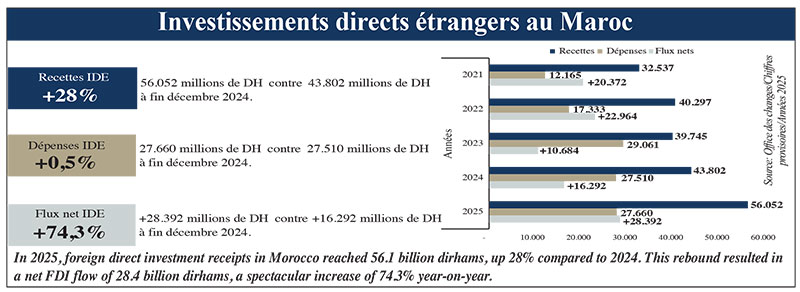
Morocco is showing exceptional performance in terms of foreign direct investment. According to data from the Exchange Office, net FDI inflows reached 28.4 billion dirhams (USD 3.1 billion) in 2025, a spectacular increase of 74.3% compared to 2024. This acceleration resulted from an asymmetric dynamic. FDI receipts jumped by 28% to 56.1 billion dirhams (USD 6.15 billion) , while expenditures (reinvestments by foreign companies already established) stagnated at +0.5% (27.7 billion dirhams) (USD 3 billion) , reflecting a consolidation of existing positions rather than a disengagement.
Foreign direct investment (FDI) is concentrated in high value-added sectors: automotive, aerospace, energy, mining, transport, tourism, real estate, and trade. This specialization responds precisely to the global restructuring of value chains, where manufacturers are seeking stable, competitive platforms connected to major European and African markets.
S&P Global Ratings forecasts in its report «Moroccan Banking Outlook 2026: Economic Growth Fuels Strong Performance» that GDP growth will be maintained at an average of 4% in 2026, driven by massive infrastructure investments related to preparations for the 2030 FIFA World Cup, the expansion of transport networks and spending on energy and health.
These projects generate substantial financing opportunities through public-private partnerships, with bank lending expected to grow by 3.5%-4% in 2026 (compared to an estimated 3.1% in 2025), primarily driven by business investment loans. Business-friendly government reforms and lower interest rates are expected to boost investment in 2026, according to S&P Global Ratings.
Meanwhile, in 2025, the net flow of Moroccan direct investments abroad(Moroccan direct investments abroad (MDIAs)) was set at +8.04 billion dirhams (USD 8.81 billion), up 16.6% compared to 2024, despite a decline in expenditures (-17.1% to 22.42 billion dirhams (USD 2.458 billion) and revenues (-28.6% to 14.38 billion dirhams) (USD 1.5 billion) .
This performance is explained by the continuation of reforms undertaken in recent years to improve the business climate, modernize the legal framework for investment, and strengthen the overall competitiveness of the national economy, as highlighted by various analyses from international institutions. In an international context marked by increased competition to attract productive capital, Morocco is leveraging its structural advantages: political stability, geographical proximity to Europe, an extensive network of trade agreements, and a constantly growing skilled workforce. With net FDI inflows increasing nearly 2.5 times in two years (from 10.7 billion dirhams (USD 1.73 billion) in 2023 to 28.4 billion dirhams (USD 3.114 billion), by 2025), the Kingdom confirms its positioning as a strategic regional hub and preferred destination for international investors seeking sustainable opportunities on the African continent.
Fatim-Zahra TOHRY