Travel, education, online shopping, real estate: What’s changing for you
The Foreign Exchange Office is once again adjusting the liberalization threshold. With the 2026 General Instructions on Foreign Exchange Transactions (IGOC 2026), the institution is not limiting itself to a technical update.
It is rolling out a series of concrete easing measures that directly affect individuals, families, students, Moroccans living abroad, and businesses. This will broaden access to foreign currency without loosening controls, which remain largely exercised by banks. This new version is part of a reform process that began more than a decade ago.
First published in 2011, the IGOC instruction forms the basis of foreign exchange regulations in Morocco. Revised at regular intervals, it accompanies the gradual opening up of the national economy and the growing internationalization of economic actors.
The 2026 version confirms this gradual and controlled trajectory, designed to respond to actual usage without undermining external balances. It now remains to be seen how this new room for maneuver will actually be used.
 ■ Personal travel: Up to MAD 500,000 per year
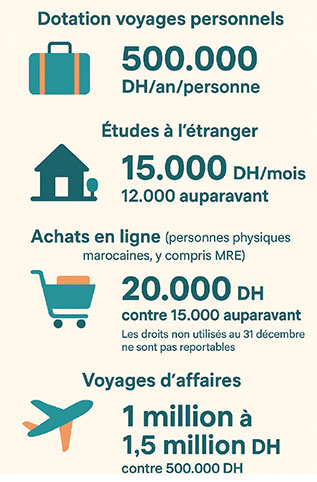
The annual allowance for personal travel has been increased to MAD 500,000 (USD 54,436) per person per year. It combines a basic allowance of MAD 100,000, which is granted automatically, and an additional allowance of up to MAD 400,000 (USD 43,544), calculated at 30% of the income tax paid in the previous year. This allowance can be used by international bank card, bank transfer, or purchase of currency in banknotes. The procedure remains unchanged: the customer contacts their bank, which checks the applicable ceiling. Any unused allowances as of December 31 cannot be carried over. IGOC 2026 extends this scheme to foreign residents, who are now aligned with Moroccans for personal travel.
 ■ Studying abroad: MAD 15,000 per month for living expenses
Tuition fees can be paid without any limit, up to the amount shown on the invoice or any document issued by the foreign educational institution. Proof of enrollment is no longer required exclusively: IGOC 2026 expands the list of acceptable supporting documents and now accepts letters of admission, acceptance, or conditional admission, particularly during the pre-enrollment phase. This is subject to the submission of final enrollment within a maximum period of four months.
Living expenses are capped at MAD 15,000 (USD 1,633) per month, up from MAD 12,000 (USD 1,306) previously. This cap may be exceeded upon presentation of supporting documents establishing the actual monthly cost. Temporary transfers are permitted in the case of pre-enrollment, pending final enrollment.
Rent and charges for student accommodation are transferable on the basis of the lease agreement, with a security deposit authorized up to a limit of three months’ rent. The entire system must be domiciled with a single bank.
■ Medical care abroad: Rights aligned for foreign residents
Transfers for medical care abroad remain authorized upon presentation of medical documentation. IGOC 2026 now aligns the rights of foreign residents with those of Moroccan citizens. The bank remains the exclusive intermediary responsible for controlling and executing payments.
■ Online purchases: 20,000 dirhams per year for individuals
For Moroccan individuals, including Moroccans residing abroad, the annual allowance for e-commerce has been increased to 20,000 dirhams (USD 2,177) from 15,000 dirhams (USD 1,633) previously. This allowance can be used to pay for purchases on foreign platforms, digital subscriptions, software, or online services.
This allowance is generally linked to an international bank card. The bank monitors the annual limit and automatically blocks payments once the amount has been reached. Any unused allowances as of December 31 cannot be carried over.
■ E-commerce: Up to MAD 2 million for start-ups
The IGOC 2026 provides for a separate scheme for businesses. Start-ups certified by the Digital Development Agency (ADD) benefit from a grant dedicated to e-commerce, increased to MAD 2 million (USD 218,000) per year, compared to MAD 1 million (USD 109,000) previously.
In addition, a minimum annual grant of MAD 50,000 (USD 5,443) has been introduced for newly created or low-taxed companies. The aim is to enable them to access the foreign digital services they need for their business, particularly in the start-up phase.
 ■ Business travel: MAD
1 million to MAD 1.5 million per year
For companies that do not have accounts in foreign currency or convertible dirhams, the annual allowance has been increased to MAD 1 million (USD 109,000) from MAD 500,000 (USD 54,436) previously. For categorized operators, the ceiling is MAD 1.5 million (USD 163,000). These allowances cover all expenses related to business travel abroad, paid by card or bank transfer under the control of the domiciliary bank.
■ Foreign investments: Nearly MAD 10 million for start-ups.
Residents can now grant asset and liability guarantees to non-resident investors. Foreign investments remain regulated, but the rules have been clarified with a stronger role for banks. The piece of legislation also extends position netting to all financial risk hedging transactions (foreign exchange, interest rates, commodities).
Similarly, a specific regime is provided for Digital Development Agency (ADD)-certified start-ups, which are authorized to invest abroad up to MAD 10 million (USD 1.09 million) per year, with no prior experience or account certification requirements.
■ Moroccan Residents Abroad and real estate: Financing up to 80% of the property value
Moroccan Residents Abroad can finance up to 80% of the value of a property in Morocco, compared to 70% previously, with no limit on the number of properties that can be financed, subject to compliance with prudential rules.
Khadija MASMOUDI