Exploratory Economic Budget: Growth Under Pressure
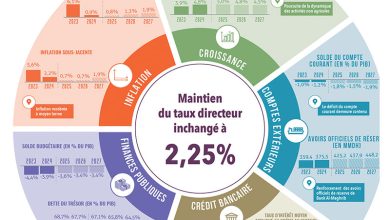
Morocco’s economy is expected to grow by 4.8% in 2026, virtually matching the pace recorded in 2025. In its Exploratory Economic Budget, the High Commission for Planning (HCP) attributes this resilience primarily to a strong agricultural rebound. Supported by abundant and well-distributed rainfall, the 2025–2026 agricultural season is expected to boost agricultural value added by 19.1%, with cereal production reaching nearly 90 million quintals. According to the Ministry of Agriculture, this represents 50.6% above the average harvest of the past ten years. By contrast, non-agricultural growth is projected to slow from 4.5% to 3.3%. The international environment underpinning the HCP’s projections is based on International Monetary Fund (IMF) forecasts. The average Brent crude oil price is expected to rise by 31.8%, reaching USD 89.2 per barrel, while natural gas prices are projected to increase by 22% and non-energy commodity prices by 18.6%.
At the same time, global economic growth is expected to slow from 3.5% to 3%, while foreign demand for Moroccan exports is forecast to weaken from 4.9% to 2.6%, reflecting the slowdown in the Eurozone, whose economy is expected to grow by just 0.9% despite remaining Morocco’s leading export market.
The industry absorbs the shock, the services sector takes over
Industry Bears the Shock, Services Take Over The external shock is expected to weigh primarily on the industrial sector. Value added in the secondary sector is projected to increase by only 1.1%, compared with 3.3% a year earlier. The chemical industry is among the sectors most exposed. Supply disruptions and higher prices for sulphur, urea and ammonia imported from the Gulf are expected to increase production costs throughout the phosphate value chain.
According to the HCP, two factors should help mitigate these pressures: the increasing production of Triple Superphosphate (TSP) within the OCP Group, and the suspension, effective July 2026, of U.S. countervailing duties on Moroccan fertilizers. Nevertheless, the extractive sector is expected to contract after expanding by 7.5% in 2025, as global demand for phosphate rock loses momentum.
The construction sector is also forecast to slow, with growth easing from 6.7% to 3.1%, as rising energy and building material costs offset the positive effects of direct housing subsidies and large-scale infrastructure projects. The services sector is expected to provide the main support for non-agricultural growth. Its value added is projected to increase by 3.9%, contributing 2 percentage points to overall GDP growth. Wholesale and retail trade should benefit from the recovery in agricultural incomes, while transport is expected to gain from higher passenger and freight traffic. The hospitality and food service sectors should also remain buoyant, supported by strong tourist arrivals and ongoing investment linked to preparations for the 2030 FIFA World Cup. Domestic demand is expected to remain the main driver of Morocco’s economy. It is projected to grow by 5.9%, contributing 6.5 percentage points to GDP growth.
Household consumption is forecast to increase by 4.4%, supported by wage increases, the recovery in agricultural incomes, continued growth in remittances from Moroccans Living Abroad (MREs), and the continuation of direct social assistance programs. Public consumption is expected to maintain growth of 4.2%, while gross investment is projected to surge by 9.5%, driven by infrastructure projects associated with major international events. The investment rate is expected to reach 35.2% of GDP, placing Morocco among the highest-investing emerging economies, albeit at the cost of a financing requirement equivalent to 3.9% of GDP in 2026, before easing to 3.6% in 2027. This domestic resilience, however, comes at an external cost. Imports of goods and services are projected to increase by 10.5% in value, outpacing export growth of 8.3%.
Khadija MASMOUDI