Labor day: The battle for purchasing power rekindled
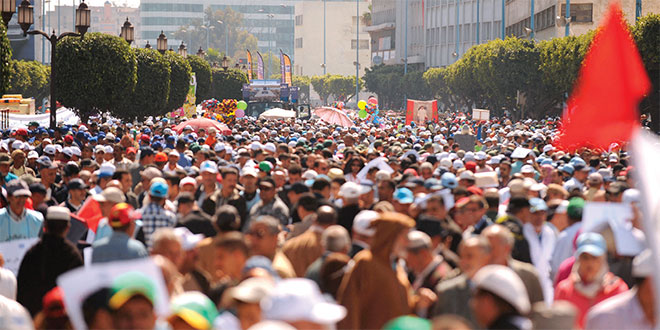
On the occasion of Labor Day, demonstrations held in Rabat, Casablanca, and several cities across the Kingdom have brought back to the forefront of social debate a key demand: the effective improvement of incomes in a context marked by macroeconomic stabilization that remains only marginally felt in households’ daily lives.
Behind the traditional slogans on purchasing power, the main trade union centers converge around a shared implicit diagnosis: the economic balances achieved in recent years have not yet translated into sufficiently visible improvements in the living standards of employees and retirees.
During their rallies, the Union marocaine du travail (UMT), the Confédération démocratique du travail (CDT), the Union générale des travailleurs du Maroc (UGTM), and the Organisation démocratique du travail (ODT) called for a general increase in wages, pensions, and family allowances, alongside a reduction in the tax burden on incomes.
Several unions also advocated for a reduction in indirect taxation on certain everyday consumer goods. Beyond wage demands, unions stress the need to redirect public policy priorities toward productive employment, tax fairness, effective social protection, and improved quality of public services. For the UMT, these levers are now essential conditions for a sustainable rebalancing of the social contract.
The mobilizations also served as a reminder of the importance of accelerating the implementation of commitments stemming from social agreements concluded in recent years. This insistence reflects a recurring concern of the labor movement: turning signed agreements into operational measures.
In the same vein, the CDT called for “translating financial balances into genuine protection of purchasing power,” through wage increases, tax relief, and strengthened social protection. Its leadership advocates the emergence of a “new social pact” linking economic development, social justice, and deeper democracy. While acknowledging recent achievements—particularly in wage increases and tax relief—the union calls for continued mobilization to fulfill all outstanding commitments.
For its part, the UGTM emphasizes the need to preserve purchasing power in the face of rising prices and imbalances observed in certain markets. The union notably calls for mechanisms to periodically adjust incomes in line with the cost of living, as well as improvements in retirees’ conditions and a stronger role for labor inspection in the private sector.
Box: Personal Income Tax Scale
The demands expressed on May 1 go beyond wage issues alone. They also cover pension reform, household taxation, and improvements in public services in health, education, housing, and employment. The ODT calls, in this regard, for a revision of the personal income tax (IR) scale and for strengthening the institutional framework of social dialogue, with a view to embedding consultation in a more structured and sustainable approach.o
Khadija MASMOUDI