Rural Transport Accessibility: Remains Unresolved
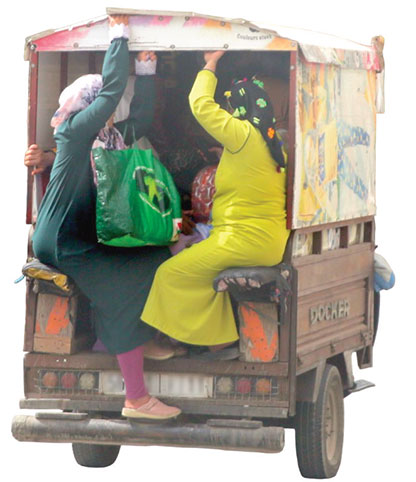
Due to the lack of a structured public transport system, informal transport has become the primary means of mobility in rural areas (Private photo)
The Economic, Social, and Environmental Council (C.E.S.E.) makes an unambiguous observation: rural transportation in Morocco remains one of the blind spots of regional public policy. Despite successive programs aimed at opening up rural and remote areas, actual accessibility remains uneven.
In other words, the presence of infrastructure does not always translate into effective mobility. The rate of access to rural roads reached 81% in 2022, up from 54% in 2005. But this indicator remains incomplete: it reflects neither the quality of the roads nor their passability. The weight of the rural world gives this issue its full significance.
In these areas, mobility directly determines access to employment, public services, and marketplace opportunities. Transportation thus becomes an essential economic infrastructure, on par with water or electricity. Investments made have expanded the road network to 57,035 kilometers (35,439 miles), but this effort has not been matched by an equivalent structuring of transportation services.
The challenge therefore lies not only in the existence of infrastructure, but in its quality, maintenance, and alignment with local needs. The availability of transportation is the main bottleneck. Transportation remains limited, irregular, and characterized by a high degree of informality. Nearly 46.5% of the rural population uses some form of transportation to get to work, but only 11.1% rely on mass transit. This gap reflects a supply that is ill-suited to users’ needs, leading to widespread reliance on individual or informal solutions. Mixed-mode transportation, long a cornerstone of the system, is now showing its limitations. The vehicle fleet is aging, underutilized, and often fails to meet safety standards. School and medical transportation also suffer from organizational shortcomings and gaps in territorial coverage. These deficiencies directly impact school enrollment, access to healthcare, and economic integration.
The economic model for rural transport remains unattractive to formal operators. Low population density and the dispersion of passenger flows make operations difficult to make profitable. This situation encourages the development of informal solutions, which provide minimal mobility without a regulated framework or sufficient safety guarantees. The market thus remains fragmented and struggles to organize itself at the regional level.
Beyond infrastructure and services, the assessment highlights a governance issue. The institutional framework remains characterized by a multitude of poorly coordinated actors. This fragmentation hinders the implementation of an integrated strategy capable of coordinating mobility, land-use planning, and economic development. Rural transportation thus emerges as a key driver of development that remains underutilized.
Amine BOUSHABA