
The Court of Cassation is overwhelmed with cases
The judicial year opened at the Court of Cassation on January 13, 2026 in Rabat. Its First President, M’hamed Abdenabaoui, presented the report of the High Court and that of the Courts of Appeal and the Courts of First Instance
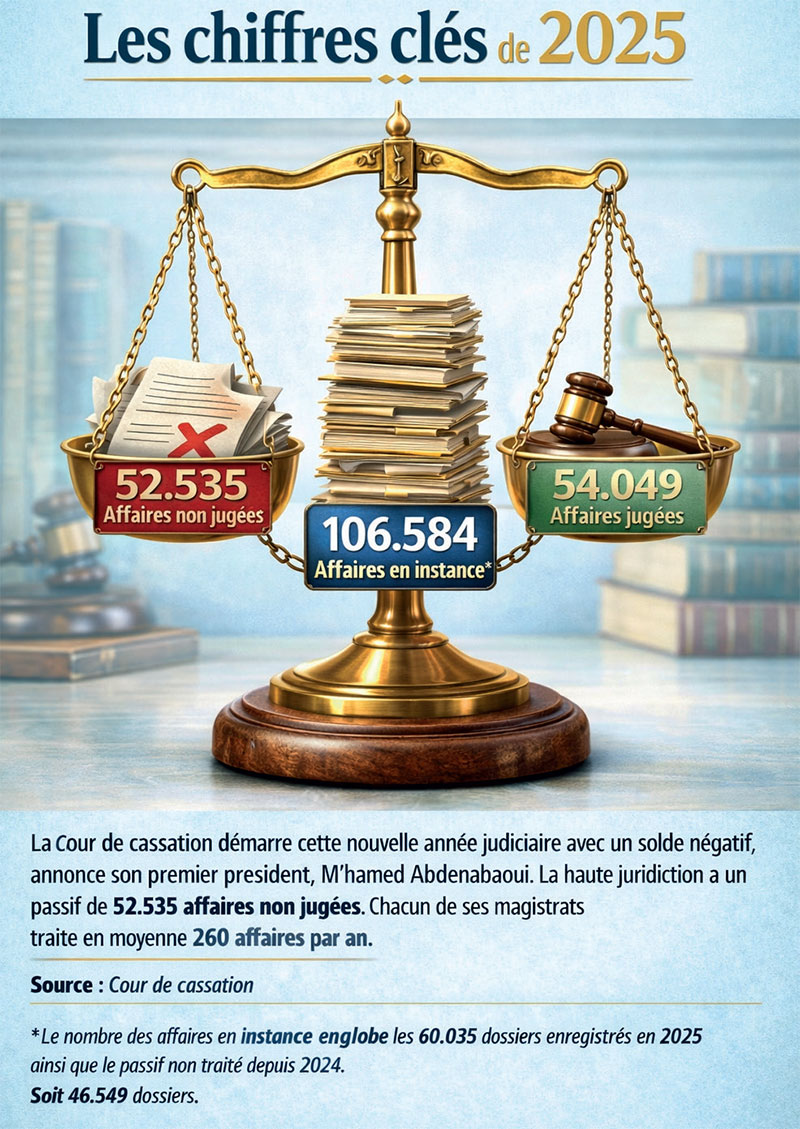
“For years, we have not hesitated to express our frustration because the Court of Cassation is overwhelmed with cases. This will affect the quality of its decisions and disrupt its jurisprudence ” , warned M’hamed Abdenabaoui . The First President of the Court of Cassation was speaking to his peers at the official opening of the judicial year on Tuesday, January 13, 2026, in Rabat. Also present were the President of the Constitutional Court, Mohamed Amine Benabdellah, state officials such as the Governor of the Central Bank, Abdellatif Jouahri , and ministers such as the Minister of Justice, Abdellatif Wahbi. The traditional formal hearing was held, as usual, at the headquarters of the Kingdom’s highest court. Similar hearings will take place throughout the month in the 33 courts of appeal.
Meanwhile, the high magistrate ‘s “voice” is addressed to citizens and lawyers concerned about the quality of justice and the rulings of the Court of Cassation, as well as to members of the Government and Parliament . M’hamed Abdenabaoui is calling on them once again to “call upon the Court of Cassation for help,” alluding to the “deluge of unproductive appeals” —these countless petitions. The court he has headed since March 2021 seems to be flooded with requests for review of cases. Importantly, the High Court does not retry the merits of a case. Its mission is limited to verifying whether the judges of the Courts of Appeal correctly applied the law, hence its crucial role in unifying and harmonizing case law. Nevertheless, these requests “are not supposed to reach the Court of Cassation. It is inconceivable to receive more than 50,000 appeals per year!” laments its First President.
M’hamed Abdenabaoui Compare this situation with that of other countries with larger populations than Morocco but half as many appeals to the Court of Cassation. Germany, with 84 million inhabitants, sees approximately 7,000 appeals per year. The French Court of Cassation, with which we share a Latin legal tradition, sees around 20,700 appeals annually for a population of 69 million. “ The Court of Cassation is not a third- instance court” , insists its spokesperson. It is not necessarily there to serve as a forum for prolonging disputes between parties who have already clashed at the trial and appellate levels. “ Its role is to regulate case law and guarantee legal certainty. This is why we must avoid overwhelming it with unnecessary appeals by establishing rigorous standards for filing an appeal to the Court of Cassation”, proposes its First President. This is not the first time this high-ranking magistrate has drawn the legislature’s attention to this judicial scourge.
And for a good reason: litigants and their lawyers are suspected of abusing the process to buy time and drag out cases. These retaliatory and delaying tactics exist even though Article 5 of the Code of Civil Procedure already requires “all litigants to exercise their rights in accordance with the rules of good faith”. Furthermore, only lawyers with at least 15 years of experience can appear before the Court of Cassation. These litigants therefore have a legal monopoly! They are, in principle, experienced. And yet, 78% of their applications were rejected in 2025, mainly on procedural grounds.
Alternative sentences: The first figures
“The courts handed down 1,001 alternative sentences between August 8 and December 31, 2025” , announced M’hamed Abdenabaoui, First President of the Court of Cassation, at the opening of the judicial year on January 13, 2026, in Rabat. The law governing this alternative to prison sentences was passed by Parliament in August 2024 and came into force a year later. An average of 200 decisions were made per month between August and December 2025. A total of 1,077 individuals had been sentenced to alternative penalties by the end of 2025, the majority to daily fines: 409 cases. Eligibility for an alternative penalty depends on the seriousness of the offense, the personal and social circumstances of the defendant, their criminal record, and their capacity for rehabilitation. These are decided by the so-called “ordinary” courts—courts of first instance and courts of appeal—in the context of a criminal trial. These alternative sentences are divided into four measures: community service ranging from 40 to 3,600 hours; electronic tagging; restriction of certain rights or the imposition of controls such as a ban on frequenting certain places, the imposition of treatment or rehabilitation; and finally, daily fines of 100 to 2,000 dirhams (USD 11 to 217) per day of imprisonment. These measures are only applicable for offenses carrying a sentence of no more than five years in prison, according to Law No. 43-22. Example: contempt of a public official in the exercise of his or her duties is punishable by three months’ imprisonment. However, these alternative penalties do not apply when a defendant is a repeat offender, i.e., when a person has committed a new criminal offense after having already been convicted once. Five repeat offenders were identified in 2025. In addition, 31 people sentenced to alternative penalties refused to comply. Just over 20 cases involved the payment of daily fines and 10 involved restrictions on certain rights or the imposition of supervision, treatment, or rehabilitation.
“The justice system is rigorous in monitoring the application of alternative sentences. These approximate data have been presented for the first time pending analysis (…) to enable criminal policy to derive the maximum benefit in terms of security, social welfare, and the economy of society,” promises the first president of the Court of Cassation.o
Faiçal FAQUIHI