Railway industry: Moroccan market attracting interest of international giants
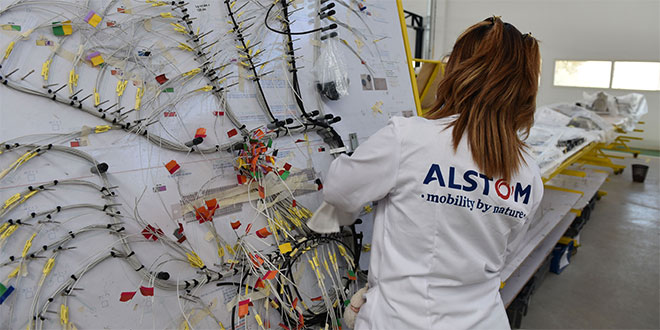
The Rail Industry Summit Morocco is back. This major event dedicated to the railway industry was held on December 9th and 10th at the Mohammed VI Exhibition Park in El Jadida. For two days, it brought together all stakeholders in the supply chain.
Morocco is engaged in an ambitious railway strategy, Morocco Rail Plan 2040, which includes the development of high-speed train lines, regional express trains (TERs) linking major cities and urban rail projects (RERs) with three lines planned for the Casablanca-Rabat-Marrakech corridor
chain : clients, equipment manufacturers, suppliers and service providers. Major national and international players thus met to do business.
Visitors came from Europe, North America, Asia, and Africa. Big names in the sector such as HYUNDAI ROTEM, ALSTOM or CAF, ANSALDO or ATLAS MOBILITY and KNORR-BREMSE RAIL SYSTEMS, were also expected.
More than 250 companies from 20 countries were to take part in this event. The stakes are high. Morocco is committed to an ambitious rail strategy, the Morocco Rail Plan 2040, which includes the development of high-speed rail lines, regional express trains (TERs) connecting major cities, and urban rail projects (RERs) with three lines planned for the Casablanca-Rabat-Marrakech corridor.
This strategic program aims to expand the national network, build new high-speed lines, and modernize rolling stock. This initiative seeks to make Morocco a major railway industrial hub, relying on partnerships with international players and the development of a local ecosystem for manufacturing trains «Made in Morocco.»
The «Moroccan Rail Plan 2040» thus plans to serve 43 cities (compared to 23 currently) and to connect 12 ports and 15 airports, thereby improving the fluidity of passenger and freight transport.
Substantial investments of around 375 billion Dirhams (USD 40.56 billion) will be mobilized to transform the country into a regional logistics center and a gateway to Africa.
The summit’s agenda included conferences on current issues in the sector, particularly major railway projects on the continent.
Furthermore, delegations from Gabon, Cote d’Ivoire, Senegal, Cameroon, and Mauritania participated in the summit to present their projects. Discussions also focused on the technological pillars of tomorrow’s rail industry, namely interoperability, cybersecurity, and AI.
Organized by the Moroccan Investment and Export Development Agency (AMDIE), the Moroccan Cluster TraIndustry (MTI) and Advanced Business Events (ABE), in partnership with the National Railway Office (ONCF), the Rail Industry Summit Morocco was also marked by the signing of agreements.
Khadija SKALLI